If you have spent any time thinking about digital marketing in the last two years, you have probably heard some version of this argument:
AI is killing SEO. Why would anyone click a search result when ChatGPT just answers the question directly?
It is a fair question. AI-powered search experiences have genuinely changed how some people find information. Google’s AI Overviews now summarise answers at the top of millions of search results. ChatGPT, Perplexity, and Claude are being used as search engines by a growing number of users. Voice assistants answer questions without ever showing a list of links.
But here is what the “SEO is dead” crowd consistently gets wrong: the fact that search is changing does not mean that the underlying need — being found by people who are looking for what you offer — has disappeared. It has not. It has just expanded into new surfaces and new formats.
The real question is not whether SEO is still necessary. It is whether the SEO you were doing two years ago is still sufficient — and for most businesses, the honest answer is no.
What AI search actually is and how it works
Before deciding whether SEO matters in an AI-driven world, it helps to understand what AI search actually does — because it is not one thing.
The three main forms of AI-influenced search
Google AI Overviews appear at the top of many Google search results pages. They are AI-generated summaries that pull information from multiple indexed web pages and synthesise it into a single answer block. Crucially, they cite sources — and those sources receive featured attribution directly in the result. Google still indexes the web. It still crawls pages. SEO still determines which pages are indexed and trusted enough to be cited.
Generative AI platforms like ChatGPT, Perplexity, and Claude are increasingly used as search alternatives. These tools do not crawl the web in real time (though some have web browsing capabilities). They draw on training data, indexed sources, and increasingly on real-time web search. When someone asks ChatGPT a question and it references a specific brand or website, that reference comes from somewhere — and well-optimised, authoritative, clearly-structured content is far more likely to be that source.
Voice search and AI assistants — Siri, Alexa, Google Assistant — answer spoken queries with a single synthesised response. There are no “ten blue links.” There is one answer. That answer still comes from a web page somewhere, and the page chosen is almost always one that ranks well in traditional organic search.
What they all have in common
Despite their differences, all three forms of AI-influenced search share one critical characteristic: they still depend on content that exists somewhere on the web. AI does not generate information from nothing. It synthesises, summarises, and attributes content that was created, published, and made discoverable through — yes — search engine optimisation.
What has genuinely changed
Saying “SEO still matters” does not mean nothing has changed. A lot has changed, and ignoring those changes is just as dangerous as concluding that SEO is irrelevant.
Click-through rates on informational queries have dropped
When Google’s AI Overview answers a question fully — “how long does SEO take to show results” — a meaningful proportion of searchers never click through to a source. They got the answer. They are done. This is a real traffic shift for content that targets purely informational queries without offering something beyond the basic answer: depth, examples, tools, interactivity, or a reason to explore further.
Zero-click searches have grown significantly
Research consistently shows that a large proportion of Google searches now end without a click — particularly on mobile. Featured snippets, knowledge panels, local packs, and AI Overviews all contribute to this. Businesses that built their entire traffic strategy around informational blog content ranking for question-based queries are seeing real impact.
The bar for content quality has risen sharply
Google’s helpful content updates, combined with the availability of AI-generated content at scale, have pushed quality signals higher. Generic, thin, or obviously AI-generated content performs significantly worse than it did three years ago. Content that demonstrates genuine expertise, provides specific and verifiable information, and shows evidence of real-world experience — what Google calls E-E-A-T (Experience, Expertise, Authoritativeness, and Trustworthiness) — performs significantly better.
New surfaces require new optimisation signals
Being cited in an AI Overview, mentioned by Perplexity, or recommended by ChatGPT are now legitimate traffic and brand discovery channels. But they operate on different signals from traditional organic rankings. This is where AEO (Answer Engine Optimisation) and GEO (Generative Engine Optimisation) come in — and why a modern SEO strategy needs to think beyond Google’s ten blue links.
SEO vs. AEO vs. GEO: understanding the difference
These three terms describe overlapping but distinct optimisation approaches. Understanding them helps explain why SEO alone is no longer sufficient — and why it is still the foundation everything else is built on.
|
SEO |
AEO |
GEO |
| Full name |
Search Engine Optimisation |
Answer Engine Optimisation |
Generative Engine Optimisation |
| Primary target |
Google, Bing organic rankings |
Featured snippets, AI Overviews, voice search |
ChatGPT, Perplexity, Claude, Gemini |
| Core signal |
Backlinks, content quality, technical health |
Clear definitions, FAQ structure, structured data |
Citations, brand mentions, authoritative sourcing |
| Content format |
Long-form articles, service pages, landing pages |
Concise direct answers, Q&A format |
Cited expertise, verifiable data, specific claims |
| Result type |
Ranked link in search results |
Answer box / AI Overview citation |
Mention or recommendation in AI response |
| Time to result |
3–12 months |
4–12 weeks (for featured snippets) |
Ongoing — depends on training and crawling cycles |
| Still requires |
All SEO foundations |
Strong SEO as a prerequisite |
Strong SEO + AEO as prerequisites |
The relationship between these three is sequential, not parallel. AEO builds on SEO. A page that does not rank cannot earn a featured snippet. GEO builds on both. An AI platform cannot cite a source it cannot find — and the sources it cites most reliably are those with strong organic authority and clear, structured content.
This means the correct response to AI search is not to abandon SEO. It is to layer AEO and GEO signals on top of an already strong SEO foundation.
What a modern search optimisation strategy looks like
If you accept that SEO remains necessary but insufficient, the next question is what to add. Here is how a contemporary approach breaks down across all three dimensions.
Technical and on-page SEO — the unchanged foundation
The technical requirements of search have not become less important because of AI. If anything, they have become more important because AI crawlers depend on the same signals as traditional search bots:
- Page speed and Core Web Vitals — slow pages are deprioritised by both Google and AI crawlers
- Mobile usability — still a primary ranking signal
- Crawlability and indexation — pages that cannot be crawled cannot be cited
- Structured data / schema markup — increasingly important for AI Overview eligibility
- Clean URL structure — helps search engines understand page hierarchy
None of this has changed. All of it still matters.
Content strategy — what needs to evolve
The type of content that performs well is shifting. The distinction that matters most is between content that gives an answer and content that earns a visit.
Content that gives an answer (and is increasingly consumed without a click):
- Simple definitions
- Basic how-to explanations
- Comparison tables
- Quick factual responses
Content that earns a visit (and remains click-worthy even in an AI search world):
- Original research and proprietary data
- Detailed case studies with real outcomes
- Step-by-step guides that require active implementation
- Interactive tools and calculators
- Opinion and perspective that cannot be summarised without losing its value
- Content that references specific, verifiable examples
The practical implication: shift investment toward content that cannot be fully consumed in a summary. Use informational content to establish topical authority and drive AI citations, but build commercial pages around depth and specificity that keeps searchers engaged once they arrive.
AEO signals — structuring content to be cited
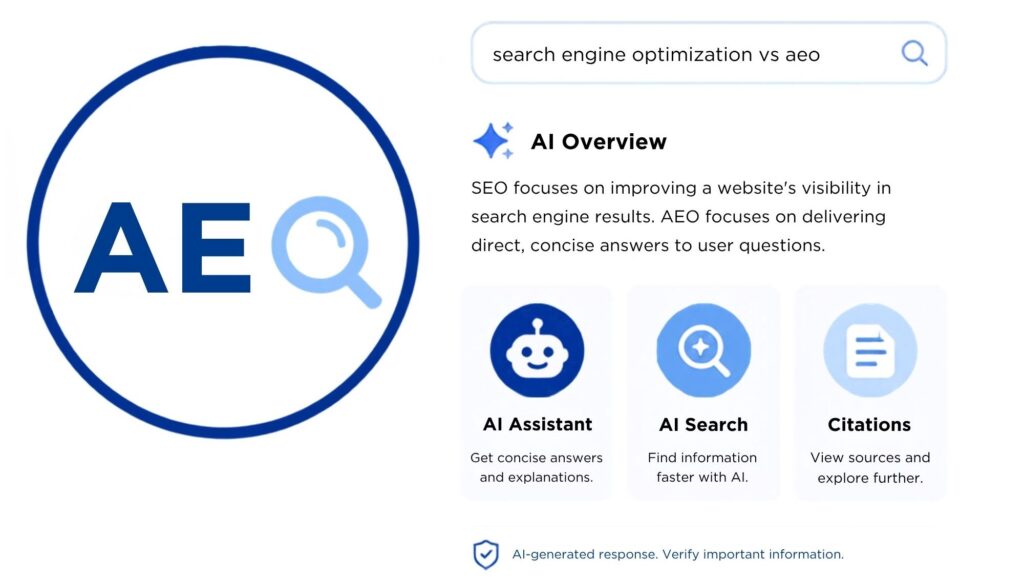
Answer Engine Optimisation is not a separate content strategy. It is a layer added to existing content that makes it more extractable by AI systems:
- FAQ sections with concise, direct answers — each question answered in two to four sentences, with the most important information in the first sentence
- Clear H2 and H3 heading structure that mirrors the questions people ask
- Definition-first paragraphs — leading with the direct answer before expanding
- FAQ schema markup in the page’s structured data
- Specific, verifiable claims with dates, numbers, and named sources rather than generalisations
When Google’s AI Overview cites a source, it is almost always pulling from a section of content that is already well-structured — not from dense paragraphs of flowing prose.
GEO signals — building the authority AI platforms trust
Generative Engine Optimisation is the least understood of the three, partly because the signals are less transparent. But the pattern is consistent across what the research and practitioner community understands so far:
- Brand mentions across authoritative sources — the more credible external sources reference your brand, the more AI platforms recognise it
- Consistent, accurate information across the web — NAP consistency, consistent brand description, and consistent claims across all your content
- Original data and research — AI platforms preferentially cite sources that provide data others reference, not sources that summarise others’ data
- Being cited in training and crawled content — content that has been live, indexed, and linked to for longer has a higher probability of being represented in training data
Which businesses are most affected by AI search — and which are least
The impact of AI search varies significantly by business type, keyword category, and audience behaviour.
Most affected
- Informational content businesses — blogs, publishers, and educational sites whose primary traffic driver is question-based informational queries that AI Overviews now answer directly
- Simple comparison or review sites — where the basic comparison is being surfaced by AI without a click required
- Businesses whose SEO strategy was built almost entirely on informational blog content without strong commercial page rankings as a complement
Least affected
- Local service businesses — “dentist near me” and “plumber open now” still produce a Local Pack, not an AI Overview; local SEO is largely unaffected
- Ecommerce stores — transactional product searches still drive clicks; people buying a product need to actually visit the store
- Businesses with strong branded search — navigational queries (“SEO Company Bangkok” as a brand search) are not replaced by AI summaries
- Businesses ranking for high-intent commercial queries — “best SEO agency for ecommerce” is a query that still drives clicks because the searcher needs to evaluate and contact, not just read a summary
The businesses most exposed to AI search disruption are those that built traffic on informational queries without also building rankings on commercial and transactional keywords. The businesses least exposed built SEO strategies around genuine commercial intent from the start.
Conclusion
AI has changed search. It has not ended. The searcher’s need — to find credible, relevant information and to connect with businesses that can help them — has not disappeared. The surfaces through which that connection happens have multiplied.
For businesses, the correct response is not to panic about AI replacing search, and not to ignore the changes and keep doing exactly what worked in 2021. It is to build on a strong SEO foundation, layer AEO content structure on top of it, and understand that being cited by AI platforms is an extension of the same authority-building work that SEO has always required.
The businesses that will win search visibility in an AI-influenced world are the ones that are findable, authoritative, specific, and genuinely useful — which is, and always has been, what good SEO was supposed to produce.

 Answer Engine Optimisation is not a separate content strategy. It is a layer added to existing content that makes it more extractable by AI systems:
 Generative Engine Optimisation is the least understood of the three, partly because the signals are less transparent. But the pattern is consistent across what the research and practitioner community understands so far: